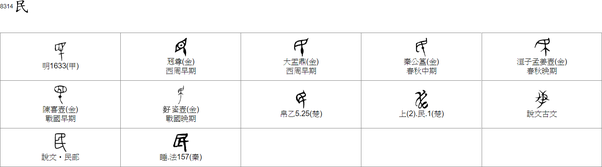
I thought I’d post a response to Kang-Lin Cheng’s post as to where 「民」 came from and how it got its meaning today.
「民」 (slave > the common people) originally depicted an eye 「目」 getting jabbed by a sharp object. It is unclear what the oracle bone form of the sharp object was, but in the bronze inscription forms the object is written as a needle 「十」 (針). This was either a procedure enacted to mark someone as a slave, or a punishment for slaves. As slaves were part of the lower class, 「民」 started to mean the common people (we’re all slaves to the nobles and the emperors, right??) and stopped meaning slave quite early on.
Some partial transcriptions/translations:
Shang Dynasty, oracle bone script
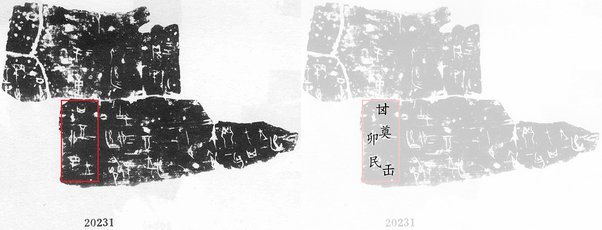
卯(劉)民𠀠(其)奠𠙻(王)
Sacrifice (kill, 劉) the slaves (民) as offerings (奠) to the king (王)
Western Zhou, bronze inscriptions
《殷周金文集成》2837 (Great Yú Tripod)
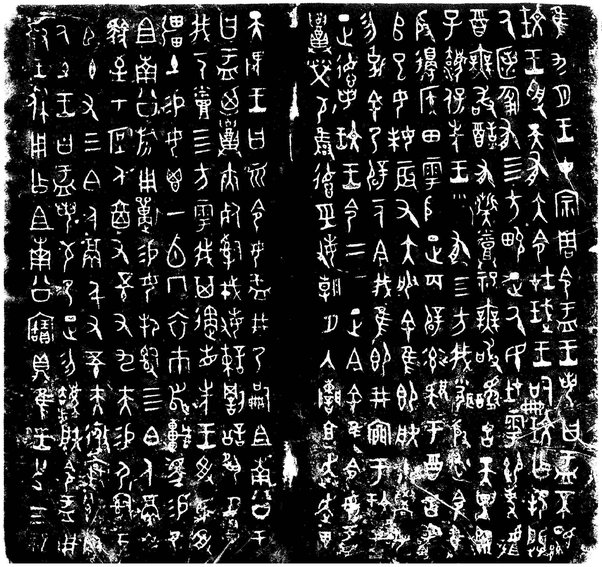
隹(唯)九月,王才(在)宗周令(命)盂。
‘Tis the ninth (九) month (月), and the King (王) commanded (命) Yú (盂) at Zōngzhōu (宗周).
王𠭞(若)曰:「盂,不(丕)顯玟(文)王𠭧(受)天有(佑)大令,在珷(武)王,嗣玟𠆦(作)邦,𨳦(闢)氒(厥)匿(慝),匍(溥)有亖(四)方。㽙(畯)正(政)氒民。在𩁹(于)⿰午卩(御)叓(事),𠭯,酉(酒)𣞤(無)𣆸(敢)⿰酉⿱舌火(酖),有頿(祡)𧯦(烝)祀,𣞤𣆸⿰酉夒(醉),古(故)天𠔱(異)臨子,灋(廢)保先王,[匍]有亖方。我𡕽(聞)殷述(墜)令,隹殷邊𥎦(侯)、田(甸)、𩁹[殷]正[百]辟,率⿰旡攴(肄)于酉,古喪𠂤(師),巳(祀)。女(汝)妹(昧)辰又(有)大服,余隹卽𦨶(朕)小學。女勿⿰㲋匕(蔽)余𠄎(乃)辟𠆣(一人)。今我隹卽井(型)𢈺(稟)于玟王正(政)徳(德),𠭞玟王令二三正,今余隹令女盂𥃝(詔)𤇾(熒),茍(敬)⿸𩀢殳(雍)徳巠(經),敏𣶃(朝)夕入讕(諫),亯(享),𧾭(奔)𣥚(走),𩱻(畏)天𩱻(威)。」
The King (王) thus (若) said (曰): “Yú (盂)! The Most Great (丕) and Wise (顯) King Wén (玟王) had received (受) the divine (天) assistance (佑) of the Mandate of Heaven (大命). King Wǔ (珷王) had inherited (嗣) the crown, and established (作) our kingdom (邦), purging (闢) our land of wickedness (慝). Boundless (溥) are (有) our lands in the Four Directions (四方), and long (畯) will our reign (政) be over The People (民)! Indeed, during (在于) governance (御事), one mustn’t (無) dare (敢) to indulge in alcohol (酖), and one mustn’t be drunk (醉) when the Rituals (祡烝祀) are to be held. Thus (故), God (天) provides assistance (異臨) in all their benevolence (子), and continues to provide great (廢) protection (保) to our founding father (先王); boundless are our lands in the four directions (溥有四方)! I (我) have heard (聞) of the loss (墜) of Mandate of Heaven (令) by Yīn (殷); alas, the lords of Yīn’s (殷) vassal states (邊), near (正百辟) and far (侯, 甸), have all (率) wallowed in drunken addiction (肄于酒), leading (故) to the loss (喪) of the army (師), rites (祀), and thus the throne. You (汝) have gained (有) crucial responsibilities (大服) before attaining maturity and wisdom (昧辰), and thus I (余) will (卽) grant you entry to my (朕) noblemens’ school for youths (小學). Don’t (勿) you (女) deceive (蔽) me (余), your king (辟)! Now (今), I (我) will (卽) follow in my ancestors’ footsteps (型), carrying on (稟) King Wén’s (玟王) decrees and governance (政), and acting with morality and integrity (德). Like (若) King Wén’s trust in a few of his ministers (二三政), now (今) I (余) order (命) you (女), Yú (盂), to guide and assist (詔熒) me. Respect (敬) social harmony (雍), honour (德), and law and order (經), diligently (敏) discuss and advise (入諫) your king from dawn (朝) till dusk (夕), perform the rites (享), and tirelessly (奔走) attend to the kingdom’s duties, in reverence (畏) of the might (威) of Heaven (天).