Many Chinese people take pride in the fact that their language is supposed to be impossibly difficult for foreigners to master (many westerners also assume this to be true).
Shh…! Don’t tell anybody this secret! Actually, learning basic Chinese is quite easy, but only if you have the right attitude, the right approach and the right tools.

Chinese grammar is quite easy: there are no verbs to conjugate (not even present, past, and future verb forms), no masculine, feminine and neuter nouns (not even singular and plural distinctions), no irregular adjectives (not even comparative and superlative forms). After you have learned a few hundred basic morphemes, you can start to recognize (and maybe even create a few of your own) entirely new words.
If you ever decide to build on your basic knowledge and learn how characters are formed, you will find that learning to recognize characters and compound words is actually much easier than it seems.
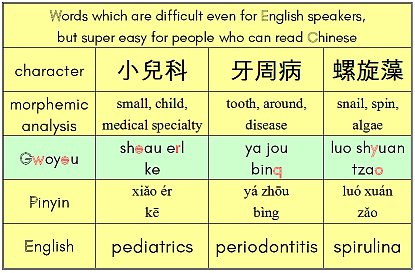
Below are three Chinese words which are super easy for people who can read Chinese: 小兒科, 牙周病, 螺旋藻. Indeed, even a second- or third-grader could probably tell you what they mean. Their English equivalents (pediatrics, periodontitis and spirulina) are words which many high school graduates might have trouble with:
I strongly advise you NOT to start with Hanyu Pinyin, a frustrating system designed to meet the needs of linguistically unsophisticated Chinese learners, but quite puzzling for foreign beginners. Hanyu Pinyin makes a western beginner’s task unnecessarily difficult:
(1) Different spelling, same sound: “wei” and “ui”, “you” and “iu” represent the same vowel
(2) Same spelling, very different sound: “u” = /u/, /w/ and /y/; “i” = /i/, /j/, and /ɩ/; “e” = /ɛ/ and /ɤ/
(3) Critical tone differences are marked with hard-to-type, hard-to-remember (for foreigners) diacritics
Point (3) is the most important. Chinese has very, very few syllable types (about 400). This is why there are hundreds of common words in Chinese with exactly the same vowels and consonants, but different tones.
Even if you only want to learn the bare minimum to engage in friendly chats on everyday topics (i.e. you don’t intend to study Chinese characters or learn to speak like an educated adult), you MUST learn the four tones and you MUST learn them very, very well. Otherwise, trying to have conversations with anybody but patient teachers who often deal with foreigners will be extremely frustrating. Many people will be unable to guess what you’re trying to say, and you won’t understand them either.
Below are three series of real words (not the isolated morphemes that Chinese people call “words”) that differ only by tone.
Line 1 in each series gives you the Chinese characters for each word.
Line 2 shows you how these words are romanized in Hanyu Pinyin (60-year-old PRC system that uses optional diacritics): notice how in Pinyin all these different-sounding words are spelled exactly the same way.
Line 3 shows you how these words are spelled in Gwoyeu Romatzyh (90-year-old system that makes different-sounding words look different).
Example: 3rd tone syllables in Mandarin sound much longer than all the other tones. This is why 1.1 duu, 1.6 toong, 2.3 and 2.4 chaang, 2.6 sheeng, 2.7 and 2.8 lii are spelled with double vowels.
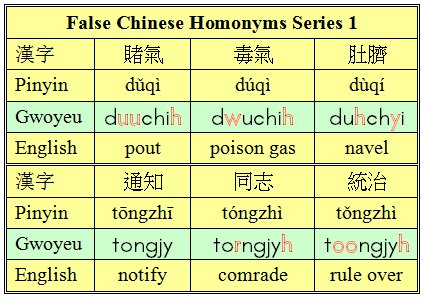
[Caption: False Chinese homonyms (duqi x 3, tongzhi x 3]
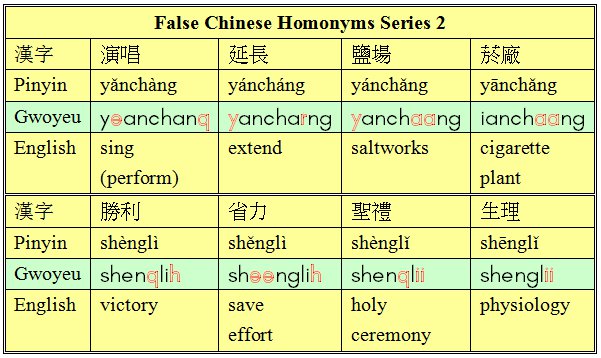
[Caption: False Chinese homonyms (yanchang x 4, shengli x 4, jiangshi x 5)]
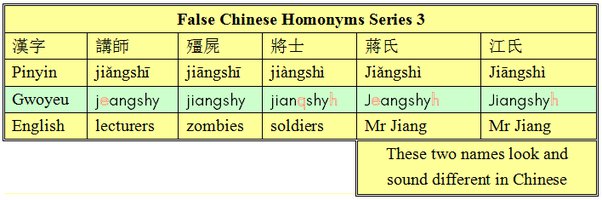
[Caption: False Chinese homonyms (jiangshi x 5)]
False Chinese homonyms are Mandarin words that are spelled very differently in Gwoyeu Romatzyh, but look superficially the same in Hanyu Pinyin (same consonants and vowels: the only difference is a tiny, eyestrain-inducing diacritic)
If you want to learn to pronounce Chinese properly, remember Chinese words (consonants and vowels plus tones!), and understand what people are saying to you, Gwoyeu Romatzyh (Chinese tonal spelling) is a great tool to help lay a sound foundation. GR takes a little bit more time to learn than Hanyu Pinyin, but the results can be very rewarding (people who grew up in the PRC and foreigners who first learned Pinyin tend to misunderstand this system).
My Chinese is self-taught: I first familiarized myself with all common transcription systems (Wade-Giles, Yale, EFEO, Palladius, Hanyu Pinyin, Bopomofo and Gwoyeu) before settling on GR as my primary tool for learning Chinese. I am convinced that using National Romanization is one of the main reasons why my tones are so accurate (more than once, in dark taxis or on the phone, I’ve been taken for a native speaker).
Teaching materials, recordings and dictionaries that use GR Tonal Spelling are slightly outdated, but still available. Of course, the majority of teaching materials and dictionaries are written in Pinyin, so you will have to learn it eventually.
After you have laid a sound foundation with GR: recognition of spoken Chinese [CRUCIAL: 99.5% of tones]), a few hundred content words, particles and other function words, basic grammar patterns, you can spend half an hour or so figuring out the minor differences between GR and Pinyin.