
For many Mandarin learners, Chinese music feels like an enjoyable and natural way to immerse themselves in the language. But one important question remains:
Can listening to Chinese songs actually help you master Mandarin tones?
The short answer is: yes—but only to a certain extent. Chinese music can support some aspects of language acquisition, but relying on songs alone to learn tones may actually create confusion.
Let’s examine what linguistic research, language teachers, and experienced learners have discovered.
Why Are Mandarin Tones So Important?
Mandarin Chinese is a tonal language, meaning that the pitch pattern used when pronouncing a syllable changes its meaning.
For example:
- mā (妈) — mother (first tone)
- má (麻) — hemp (second tone)
- mǎ (马) — horse (third tone)
- mà (骂) — scold (fourth tone)
Even if consonants and vowels are pronounced perfectly, incorrect tones can completely change what you are saying.
Because of this, tone acquisition is often considered one of the biggest challenges for non-native Mandarin learners.
What Does Research Say About Music and Tone Learning?
Recent studies suggest that musical ability is positively associated with Mandarin tone learning.
A study published in Studies in Second Language Acquisition found that learners with stronger musical abilities tended to perform better in Mandarin tone-word learning tasks. Researchers concluded that sensitivity to pitch may facilitate the acquisition of lexical tones.
A 2024 review titled Enhancing Tonal-Language Learning Through Music also reported that musical training may improve pitch perception, an essential skill for recognizing tonal distinctions in languages such as Mandarin.
However, researchers also emphasize that musical exposure alone is insufficient. Active pronunciation practice and targeted tone training remain necessary.
The Big Problem: Mandarin Songs Don’t Always Preserve Tones
This is where things become complicated.
Unlike normal speech, songs follow a musical melody, which often overrides the natural pitch contours of Mandarin tones.
As a result:
- First tones may rise or fall.
- Fourth tones may be sustained.
- Tone distinctions can become blurred.
Many experienced Mandarin learners report that while songs help with vocabulary and listening enjoyment, they are unreliable for learning accurate pronunciation.
Interestingly, tonal languages differ in this regard. Cantonese songs generally preserve lexical tones more faithfully than Mandarin pop music.
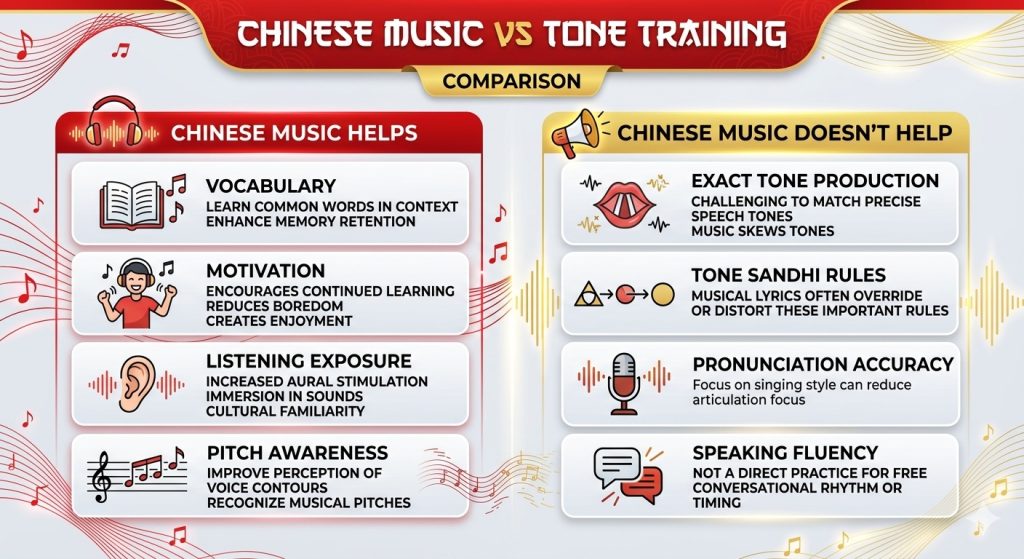
So, Can Chinese Music Help with Tones?
The answer is both yes and no.
Chinese music CAN help with:
1. Developing Pitch Awareness
Frequent exposure to melodies may improve your sensitivity to pitch differences.
Research suggests that individuals with musical backgrounds often distinguish Mandarin tones more effectively.
2. Improving Listening Motivation
Listening practice is essential, and music makes repetitive exposure enjoyable.
Learners who enjoy Chinese songs often spend significantly more time engaging with the language.
3. Reinforcing Vocabulary
Repeated lyrics help learners remember:
- Common expressions
- Sentence patterns
- Colloquial vocabulary
This indirect exposure contributes to overall language proficiency.
4. Enhancing Prosody and Rhythm
Songs can help learners become familiar with the natural flow and rhythm of Mandarin, even if the tones themselves are modified.
Chinese Music CANNOT Replace Tone Training
If your goal is accurate pronunciation, songs should not be your primary learning method.
Music alone cannot teach:
- Exact tone contours
- Tone pairs
- Tone sandhi rules (such as third-tone changes)
- Natural spoken intonation
Language experts consistently recommend combining music with structured pronunciation practice.
The Best Way to Use Chinese Songs for Tone Improvement
Instead of avoiding music entirely, use it strategically.
Step 1: Learn Tones First
Build a strong foundation using:
- Pinyin tone drills
- Minimal pair exercises
- Tone pair practice
- Native audio recordings
Step 2: Study Lyrics Separately
Before listening repeatedly:
- Read the lyrics.
- Add pinyin and tone marks.
- Understand the meaning.
This prevents incorrect tonal associations.
Step 3: Shadow Native Speech
Use podcasts, dialogues, or graded readers with audio.
Research shows that active imitation, known as shadowing, improves pronunciation much more effectively than passive listening.
Step 4: Use Songs as Reinforcement
Once you already know the tones of words, songs become excellent tools for:
- Vocabulary retention
- Listening enjoyment
- Cultural immersion
Think of music as a supplement rather than a teacher.
Recommended Alternatives for Tone Practice
For serious tone improvement, prioritize:
- Native speaker recordings
- Pinyin trainers
- Tone pair drills
- Speech shadowing exercises
- Pronunciation feedback from tutors
- Speech analysis tools that visualize pitch contours
Studies indicate that visual feedback combined with auditory practice can significantly improve tonal accuracy.
Final Verdict
Does listening to Chinese music help with mastering Mandarin tones?
Partially.
Chinese songs can:
✓ Increase exposure to Mandarin
✓ Improve pitch sensitivity
✓ Boost motivation and vocabulary retention
✓ Make language learning more enjoyable
However, they cannot reliably teach accurate tones, because musical melodies frequently alter natural Mandarin pitch patterns.
The most effective approach is to combine music with deliberate pronunciation practice.
So keep enjoying your favorite Chinese songs—but don’t let them be your only tone teacher.
In Mandarin learning, music is a valuable companion, not a substitute for focused tone training.