A single Chinese symbol can mean “to hit,” “to fetch,” “to play,” or “a dozen.” How do seven-year-olds memorize dozens of definitions for one character? They don’t.
The secret lies in how the language is structured and taught. Modern Chinese is overwhelmingly a language of compound words, not isolated characters. In school, students are rarely taught a character’s ten possible definitions all at once. Instead, they learn characters within the context of specific two- or three-character words (词, cí).
Take the character 打 (dǎ), which is notorious for having dozens of meanings. Instead of memorizing a list of definitions, children learn the character as part of distinct vocabulary words:
- 打球 (dǎ qiú) = to play ball
- 打电话 (dǎ diànhuà) = to make a phone call
- 打车 (dǎ chē) = to take a taxi
- 打印 (dǎ yìn) = to print
The ambiguity vanishes entirely when the character is paired with its partner. By learning compound words, the brain automatically retrieves the correct meaning based on the pairing.
Teachers also heavily emphasize radicals (部首), which are the graphical building blocks of characters that provide semantic clues. If a child is learning a character with multiple abstract and literal meanings, the radical often anchors it to a physical concept. A character with a “hand” radical (扌) almost always relates to a physical action, while one with a “water” radical (氵) relates to liquid or flow.
Furthermore, Chinese children rely heavily on their existing spoken vocabulary. Before tackling complex texts, first-graders spend weeks mastering Pinyin, the phonetic romanization system. Because they already know how to speak the language fluently, they use Pinyin to map spoken words they already understand to the new written symbols. When reading a story, the context of the sentence triggers the correct spoken word in their mind, which tells them exactly which meaning of the character is being used.
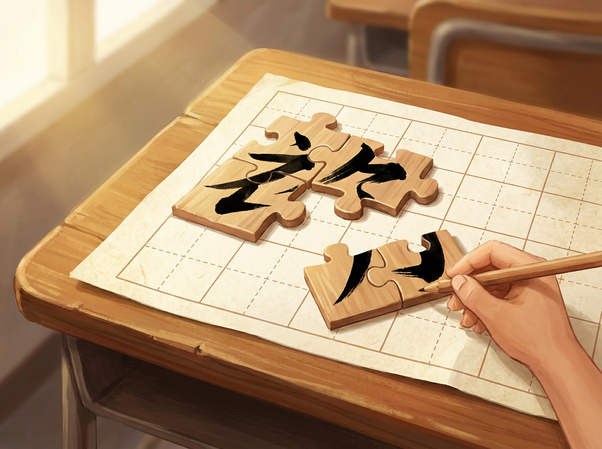
Finally, there is the reality of traditional practice. Students use grid-lined practice books (田字格, tiánzìgé) to write characters repeatedly. During these exercises, teachers require them to write a new character and immediately write down two or three common compound words that use it (a practice called 组词, zǔcí). This exercise mentally cements the character not as a confusing, multi-purpose symbol, but as a modular puzzle piece that changes its function depending on what it connects to.
