How does Chinese acquire new words if they are all different characters?

WiFi => 无线,无线网 (no wire, wireless, wireless network) Computers => 电脑,计算机 (Electronic Brain, Computating Machine) But those aren’t new words, they’ve been around for a some time. What’s something new in the realm of physics? Physics News How do you say Nanoparticles for Artificial Photosynthesis in Chinese? 以人工光合作用为目的的纳米粒子 Nano- 纳米, it’s a sound-alike, it’s also … Read more


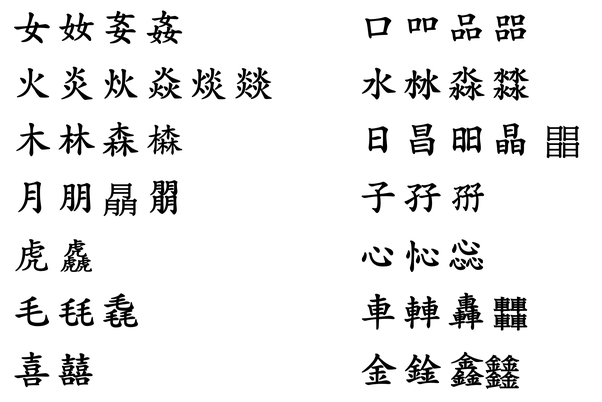
Are there other kanjis/hanzi that have like a bunch of a single radical combined to make 1 kanji/hanzi? Something like 又双叒叕 and 人从众?.

There are tons but I know some… [I know that I’m missing some more but these are what I currently know on the top of my head.] I understand that and the character’s meme: Just search “姦 meme” and you’ll know. Also, 轟 if you search-image “轟”, you’ll get the My Hero Academia character since … Read more

Is 吉蝴 a good name for a girl?

LOL, no. If you’re going for “lucky butterfly,” 吉蝴 is the worst you could go with. It’s a weird name because 蝴 isn’t a common word used for names. 吉蝶 isn’t much better. 蝴 and 蝶 aren’t very common for names. 蝶 was particularly bad for the girls’ name because, in Chinese culture, butterflies often … Read more

Can I speak in Chinese in the order of sov? Is it possible to order sov in Chinese?

Well, it depends on how you see this topic. I mean, the sentence structure of the Chinese language is usually SVO, which is subject–verb–object, or 主谓宾 in Chinese. And the word order in spoken Chinese also follows this. Of course, there are Chinese phrases and Chinese sentences whose positions of verbs and objects are reversed. … Read more

Why is Vladivostok translated as 海參崴, in Chinese?

Two theories about the meaning of 海参崴* Hǎishēnwǎi / Haeshenwae 1: Perhaps a translation of a Manchu name that means “seaside village”: ᡥᠠᡳ᠌ᡧᡝᠨᠸᡝᡳ 2: Perhaps 崴 is a local word used to form names of bays. 海参 hǎishēn / haeshen is a Mandarin word for “sea cucumber”, so 海参崴 could mean “Sea Cucumber Bay” or … Read more

What is ‘不倫’?

First, 倫 lún:this is a combination of 人 person and 侖 which is 亼 chí / ji gathering 冊 books (for those who care: 形聲必兼會意); the basic idea is thinking, and sorting into categories, specifically age groups. So the 倫 refers to the relations within the family, first and above all: between spouses, between parents … Read more