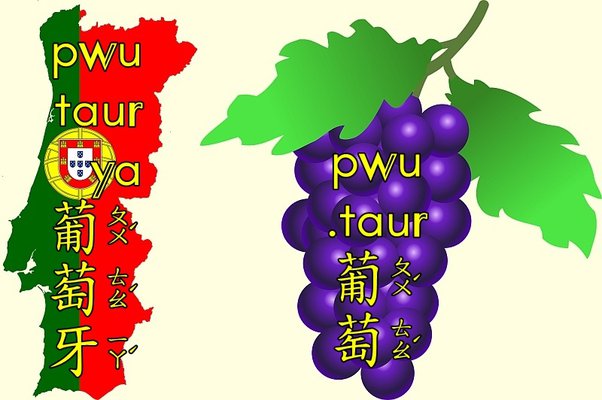
[Portugal & grapes: 葡萄牙 pútáoyá / pwutaurya & 葡萄 pútao / pwu.taur, GR Tonal Spelling (Gwoyeu Romatzyh)]
蒲陶, the Chinese word for grape, is attested over 2100 years ago in Records of the Grand Historian 《史記大宛列傳》西元前138年 (138 BCE)
「大宛在匈奴西南,在漢正西,去漢可萬里。其俗土著,耕田,田稻麥,蒲陶酒。 有蒲陶酒。」
Dàyuān zài Xiōngnú xīnán, zài Hàn zhèng xī, qù Hàn kě wàn lǐ. Qí sú tǔzhù, gēng tián, tián dào mài. Yǒu pútao jiǔ.
Dahiuan tzay Shiongnu shinan, tzay Hann jenq shi, chiuh Hann kee wann lii. Chyi swu tuujuh gengtyan tyan daw may. Yeou pwu.taur jeou.
“Dayuan lies southwest of the Xiongnu and directly west of Han, about 10,000 li from us. The local people cultivate their land: they grow rice and wheat. They have alcoholic drinks made from grapes.” [Dayuan = Dayuan – Wikipedia, Fergana – Wikipedia]
NOTE: 酒 jiǔ / jeou is a Chinese word with no exact English equivalent. Beer, wine, whiskey, sake etc. are different kinds of 酒, so I have rendered it as “alcoholic drink”
In Chinese the word 蒲陶 pútao / pwu.taur “grapes” predates 葡萄牙 pútáoyá / pwutaurya “Portugal” by a millennium.
葡萄牙 pútáoyá / pwutaurya in Cantonese sounds like the word “Portugal” in Spanish/Portuguese: pou4 tou4 ngaa4. It has nothing to do with grapes (apart from the fact that they do produce grapes: a mere pun).